Case of the Absent Hour
Key art
Filed beside the screening
The picture is Case of the Absent Hour.
Scenario
2:57 · 16:9
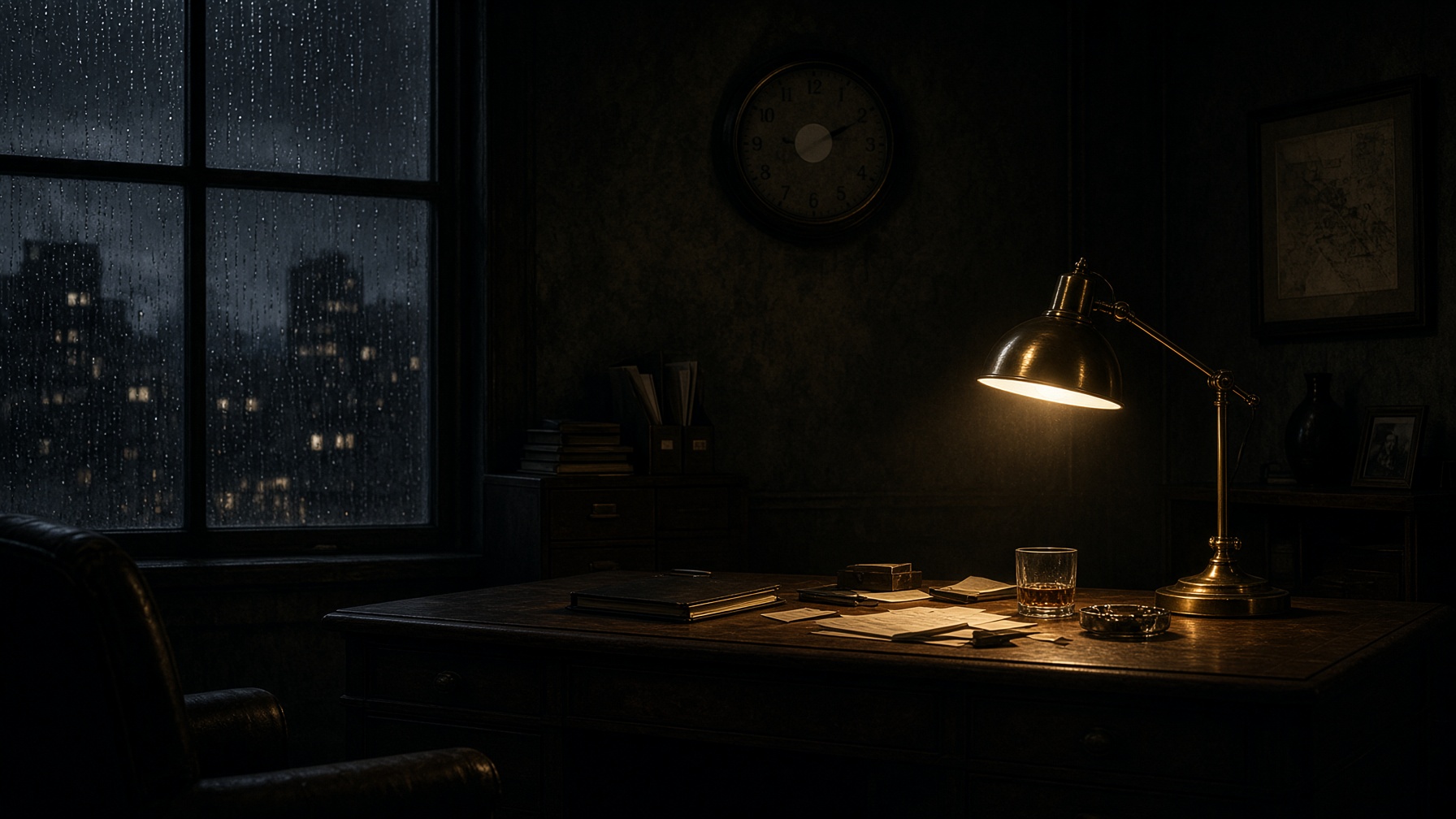
Rain ticks the window between one and two. A lamp burns over a wet desk, ordinary furniture still in its places. A red book lies in a ring of water, the dye darkening where the ring has sat longest. Beside it a clock has a round hole where a piece of its face should be. The hole is clean, as if the numeral had been lifted out rather than broken. Footprints in rainwater run from the sill to the desk. They are not the prints of the man who stands there in dry shoes, coat still on. His soles leave nothing. The wet prints are smaller in the heel and already drying at the edges.
He opens the red book. The pages hold the missing hour: damp paper, a drawing of this clock, the hole inked solid. The ink is wet enough to shine. On the desk the real hands jump from one to two and leave nothing between them. The jump is soundless. For a breath the clock is not on the desk at all. The wet prints circle bare wood, a loop with an empty center. Then the clock is back, heavier in its place, and the hole has opened past the numeral, taking the next mark with it. The hands rest on the near side of that larger absence.
The lamp buzzes, a small filament sound, and the rain does not sync to it. He turns one more damp page and finds the same drawing again, smaller, the hole already inked to the larger size, as if the book had kept the revision before the desk performed it. He does not tear the page out. The footprints by the sill darken when a fresh thread of rain reaches them through a warp in the window sash, then stop receiving water. His dry shoes stay dry.
He closes the book. The cover sticks once to the damp page and lets go. Lamp, chair, cabinet, and rain all remain in their places. He does not follow the prints to the door. His hand stays off the sill. Time passes as the ring of water around the book shrinks and the red cover buckles along one corner, then holds that buckle. The footprints lose their shine from the toes backward. The heels stay dark longer.
The inked hole in the drawing darkens to match the larger absence on the desk, the pencil circle filling itself without his hand. He watches the page through the closed cover's edge, where the paper shows, and does not reopen the book to stop it. Both hands of the clock rest on the near side of the hole. The water around the footprints dries at the edges until only the heels remain. The red book keeps its shape under the lamp, and the hour between one and two does not return to the face.