The Lost Inventory
Key art
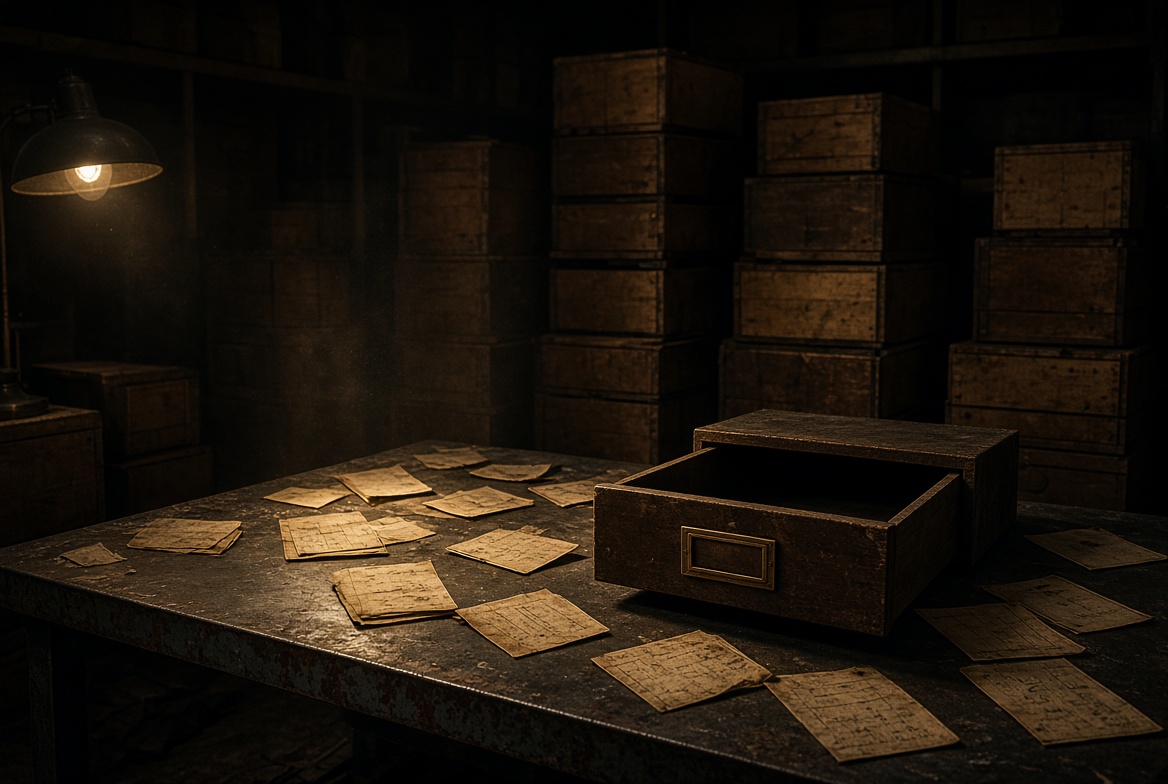
Filed beside the screening
The picture is The Lost Inventory.
Scenario
2:57 · 16:9
Leta Quarm carries a list that once kept a building from forgetting its rooms. A table lamp at the landing throws light onto a blank card clipped to the board. She has not filled the card, because the decision today is about the mismatch, not a new label. She stands under the lamp long enough for the bulb to warm the blank card's upper edge. The card stays blank. Dust on the board shows where older sheets were pinned and taken down. She walks the corridor with the list held where she can read it. Manila edges stick out of her folder, three of them, none of them the door she is looking for. The building is ordinary. Nothing groans. Nothing plays at clerks. A window at the far end gives plain daylight and no instruction.
At the first turning the doors agree with the paper. She touches nothing. At the second turning a number plate sits level, and the list has that number. She counts the doors she has passed and makes a small mark with her nail beside the count, not a correction. The nail mark is only a dent in the paper. At the third turning the list asks for a door: number 3-14, linen store. What the wall gives her is plaster. No jamb, no seam, no handle. She waits. The plaster does not develop a crack or a shadow in the shape of a door. She sets her palm flat on the place a handle would occupy. The plaster is cool and uninterrupted. The number lives on the paper and opens onto nothing that can be walked. She checks the count again. The paper and the floor do not agree, and she does not correct either of them into politeness.
She sets the folder on her knee and writes, on the list itself, only this: 3-14, wall. The ink is darker than the older entries. She does not renumber the corridor to save the list, and she does not redraw the list to pretend the door is there. While the ink dries she looks once more at the plaster. A faint scuff appears where her sleeve brushed, not an opening, only a duller patch the size of a cuff. That patch is the second change, and it follows the first: the wall stays a wall, and now it shows that she stood there. She does not wipe the scuff. The mismatch is what she keeps.
She walks back. The doors she already counted remain the doors she counted. None of them becomes 3-14 to rescue the paper. At the landing she clips the sheet under the lamp and leaves the blank card blank. The lamp warms both. The new line, 3-14, wall, stays readable. The card above it takes no writing. The nail mark beside the old count is still there, a dent and not a fix. Manila edges still stick from the folder. The plaster at the third turning, out of the lamp's reach, keeps its cuff-sized dullness and its lack of a handle.
Her list and the wall disagree in plain ink, and both stay as they are.