The Locked Gallery
Key art
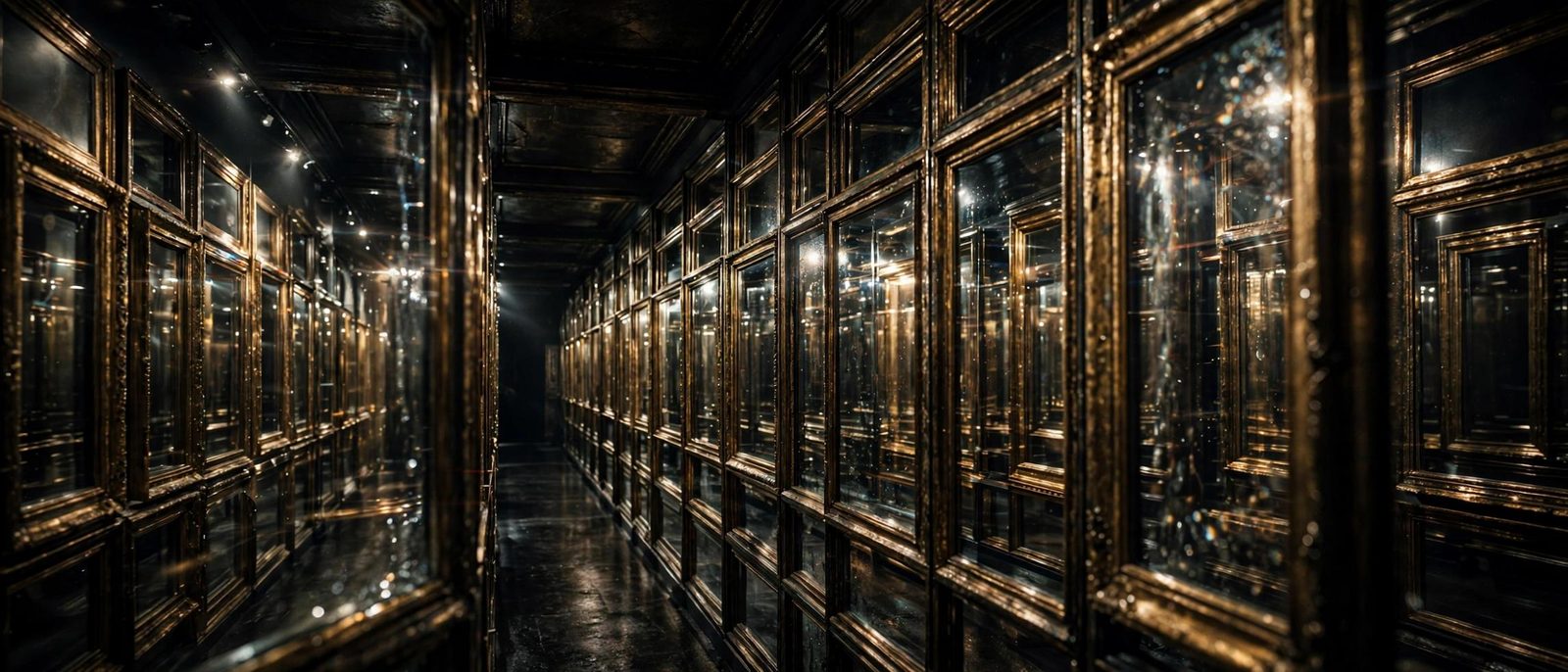
Filed beside the screening
The picture is The Locked Gallery.
Scenario
2:57 · 16:9
Gilt borders repeat down a corridor until the aisle has no end in sight. Glass covers every painting. The gold is the same at the first border and at the tenth, and the tenth is already small with distance. Two men walk the centre line. In the glass their reflections hold different stances: one a step behind his body, one turned aside, shoulder to the aisle while his shoes face forward. Their shoes sound once and the echo answers twice. The second echo arrives late, from a stretch the first echo did not use.
They pass a painting of a stair and a painting of a bare table. In both glasses the delayed reflection keeps the earlier step. The man whose glass turns him aside slows, and the turned reflection slows a moment after. The other man watches the borders. They do not stop repeating. A nick in one gilt corner catches the light and lets it go. Farther on, the same nick appears in the next border, then the next, smaller each time.
They stop where an enormous gilt border holds no canvas. The lower edge is thick enough to step over. The gallery continues inside it, the same aisle, smaller, then smaller again, until the borders become a grain that can still be followed. No painting hangs in that depth. Only the aisle, reduced. One man leans close to a painting of a bare room beside the empty border. The painted room has one chair and a shut door. His breath fogs the glass. The fog spreads, holds, and thins. The reflection in that fog does not breathe. Its mouth stays closed while his stays open. When the fog clears, the unbreathing face is still a step behind him, upright and dry.
The other man reaches a mechanical chest at the end of the hall. Papers wait on the lid, edges aligned. He lifts the lid. The hinge ticks twice, in the same doubled way as the shoes. More papers lie inside, drawings of the aisle, borders numbered in a hand that matches neither man. He turns one sheet, then another. The newest sheet already shows the first man standing within the enormous border, though that man has not stepped yet. The drawing includes the fogged glass and the chair. A lower sheet is still blank at the far end of its aisle.
The first man steps over the lower gilt edge. His shoe finds a floor that looks like the corridor and sounds thinner. His reflection stays outside, upright, in the stance he has left. He takes a second step. The reflection does not follow that one either. Farther down the repeating corridor a hooded figure walks away and does not grow smaller. The hood keeps the same size at ten paces and at thirty.
The chest remains open. Paper settles against paper and then is quiet. The blank far end of the lower sheet darkens, a small hood appearing at the size it already has, not reduced by the drawn distance. The page accepts the figure that will not shrink. The top sheet lifts in no draft and settles, inked with both men where they stand now, one inside the gilt, one at the chest.
The first man does not step back. The second does not close the lid. The unbreathing reflection holds its place on the glass of the bare room. The doubled echo dies and is not replaced. Both men stay on the top sheet, and the hood beneath them stays the size it had when the ink arrived.