The Day After Names
Key art
Filed beside the screening
The picture is The Day After Names.
Scenario
2:57 · 16:9
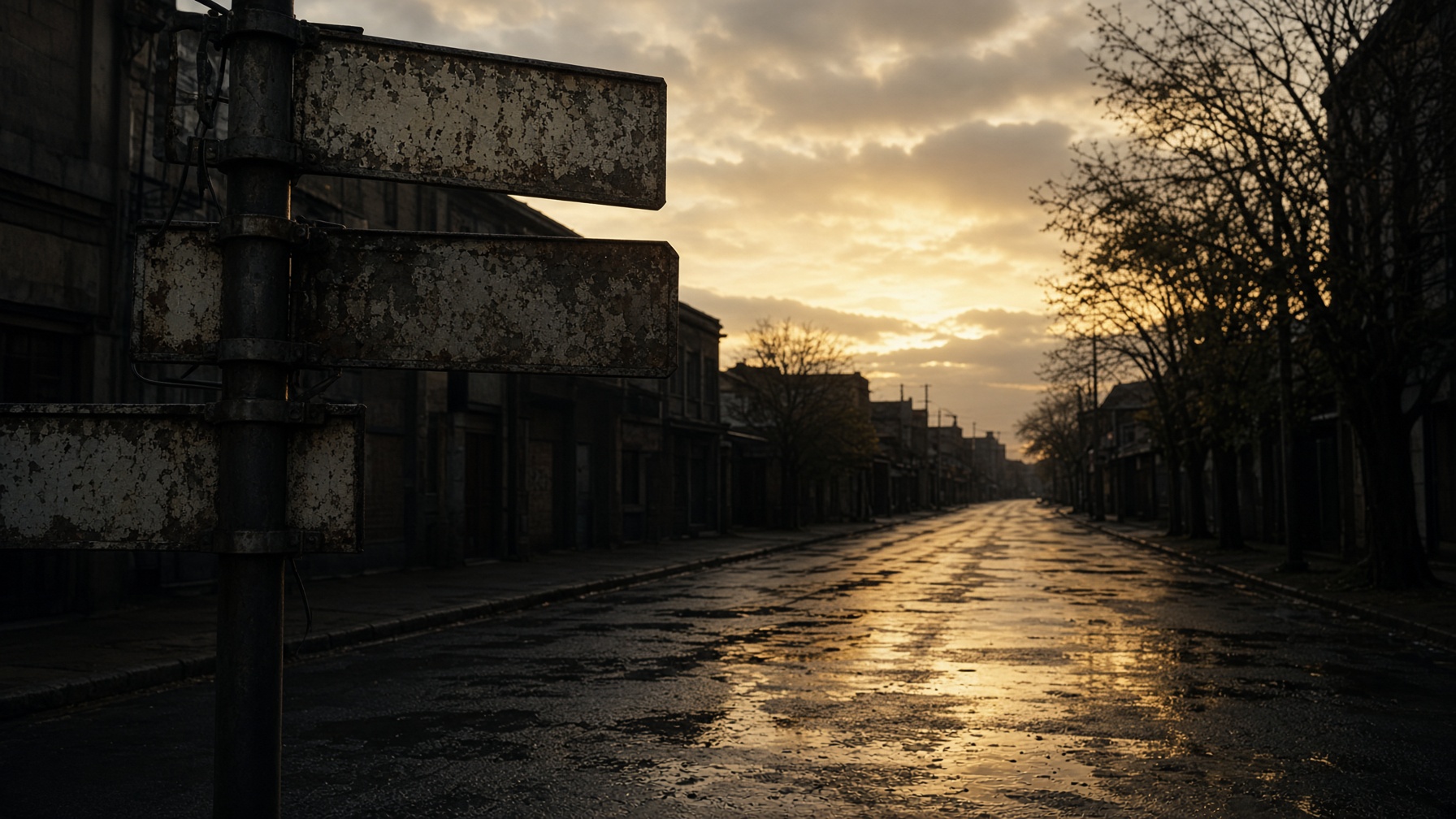
The street is still a street. Curbs meet. The roadway keeps its width. What has fallen are the names. Enamel plates lie on the paving where they dropped, letters chipped, screw holes empty. Yara Flint painted those letters when the signs still stuck. She walks the geometry now with a brush case in her hand and no title on the wall above her.
The pale outlines of rectangles remain on the brick, cleaner than the wall, the size of the plates. Screws are gone from the holes. She does not open the brush case while she walks. Her shoes avoid the plates and then stop avoiding them, because they are everywhere a name used to be. Minutes pass as that walking of angles she still knows, and as no one calling a street by a word. A bus does not come. A paper does not blow. The enamel clicks only when her shoe touches one and she steps off it.
She stops at the corner she knows by its angle, not by a word. A plate near her boot shows half a name she can still read. She crouches, lifts it, and holds it against the brick where the pale outline of a rectangle remains. The screws are gone. The plate will not take. For a moment the old work is almost back: her letters, her corner, a street that could be asked for by name. The plate's weight pulls at her fingers. The brick gives her nothing to hook. A flake of pale paint falls from the empty screw hole and sticks to the enamel. She does not press it back into the wall.
She lowers the plate and lays it with the others. Putting them up again would hire hope to do the work of a plot, and she does not. Residue is not litter to her. It is where the letters ended. She caps the brush she never opened. The half-name, set down, loses one more chip from a letter when the plate meets the paving. The chip is tiny and bright. It stays beside the plate. The loss follows the laying-down and does not ask her to paint a repair.
She walks the length of the unmarked block. The walls stay bare. The enamel stays on the ground. Fallen letters lie at the corner, and the capped brush stays in her hand. The flake of paint rides the plate she set down. No screw appears in the empty hole to invite the name back up.
The corner keeps its angle and not its word. Her brush case stays closed for the length of the block, and the chipped half-name remains among the other plates on the paving.
She does not look back at the corner to see if the plate has climbed. The block ahead is brick, mortar, and the pale ghosts of rectangles, all of them empty. A screw hole at eye level shows raw brick inside and no thread. The brush case bumps her leg and stays capped. Wind moves a plate on the paving a finger's width and cannot stand it up. The half-name she could still read stays face-up among the others, chipped, and the street keeps its curbs without anyone arriving to ask it what it used to be called.