Sacrament of Dust
Key art
Filed beside the screening
The picture is Sacrament of Dust.
Scenario
2:57 · 16:9
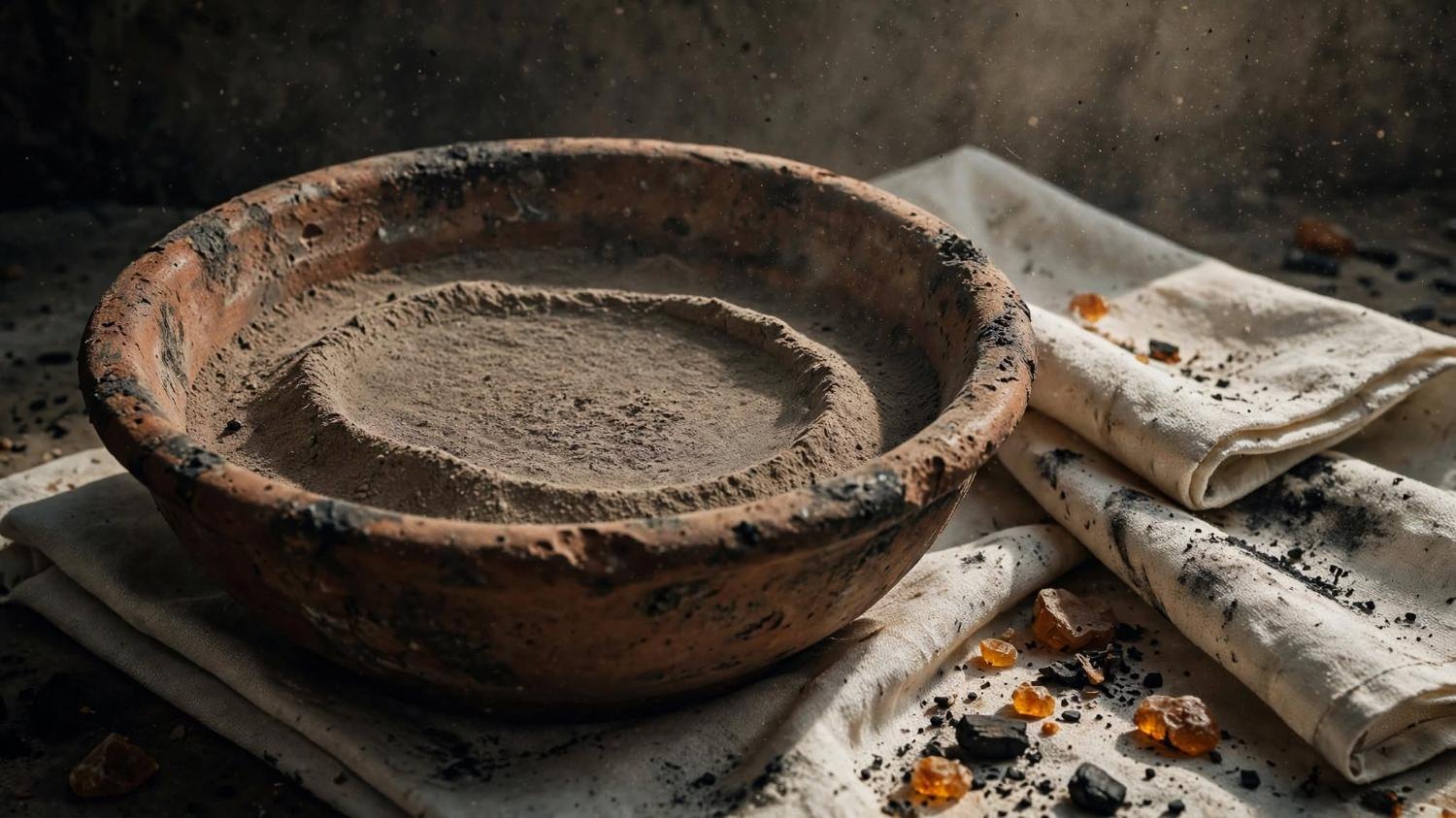
A terracotta bowl of smoothed dust sits on soot-stained linen. The dust is lower in the middle, a circle waiting for a palm. Amber resin and small coals lie beside the bowl, scattered, left rather than arranged. No hands are in the room. The black walls take no reflection. The linen holds old soot in a map of earlier spills, and the new dust stays inside the bowl.
Time in the room is the slow settle of the dust. A grain at the rim loosens, slides the inner slope, and stops in the low circle. Another follows, then stops. The coals do not light yet. The resin stays dull amber. The linen does not shift under the bowl. A minute passes as that small travel of grains and nothing else.
Two handprints press themselves into the dust. The linen does not dent. The prints are clear, palms and the spread of fingers, and then they are only prints. No wrist continues off the bowl. The dust around the prints holds the shape. The low circle is broken by the two palms. The resin and the coals lie where they were, still unlit, still scattered.
The coals in the bowl take light. Resin lights with them. A small flame sits in the dust without eating it. Sparks go up the black wall and die before the top. One spark reaches higher than the others, fails, and leaves a pale tick on the wall that cools at once. The dust brightens and does not blow away. The handprints show sharper while the light is in them.
The bowl breaks along one side. The sound is a short crack, then nothing. Dust stays in the curve that remains. Resin and charcoal spill onto the linen and stop at the soot already there. They do not run to the edge of the cloth. A few embers keep their red in the broken curve, then shrink to dark.
The handprints are split by the break, one in the shard and one in the bowl. No hands come back to match them. The shard settles a finger lower on the linen. Its print faces up. The print left in the bowl faces up as well, divided from its pair by the raw clay edge.
An ember in the shard, already gone dark, takes a last red and gives it up. A final spark climbs only halfway up the black wall, lower than the first sparks, and dies there. The mark it leaves is shorter than the pale tick above it. Ash from the resin stops where the old soot stops. The dust in the broken curve sinks a little lower in the middle and then holds.
The linen holds the spill. The black wall holds the last mark of a spark. The broken curve keeps its dust, lower in the middle, with no palm above it. The two prints stay split, and the coals do not light again.