Port of Missing Names
Key art
Filed beside the screening
The picture is Port of Missing Names.
Scenario
2:57 · 16:9
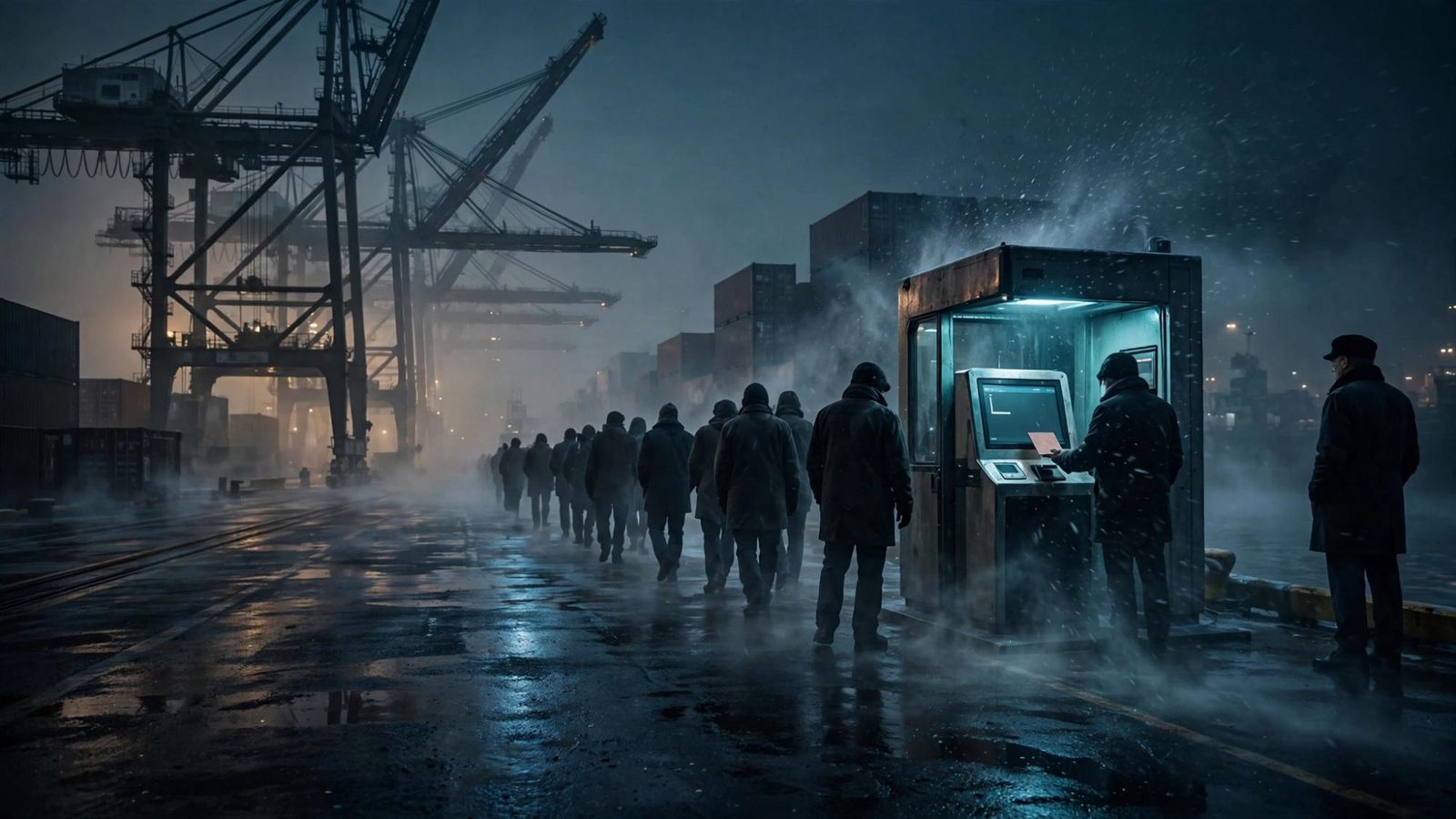
Fog sits on a wet quay. Cranes repeat into the dark, the same shape smaller and smaller. Six coated figures stand at a rusted booth whose window glows a flat white. The glow does not flicker at first. A barred terminal waits in front of the booth. Its bars are cold with damp. Beyond the cranes, a dark ship is taking coats aboard. The coats go up a gangway and do not come down. Water ticks the pilings.
Above the quay, a wet control room looks down. One hooded back is at the consoles. The back does not turn. To the right of the glass, a line of pale figures stands as light only, already processed, with no faces left to turn. Their edges are soft. They do not drip. They do not cast the shadows the coated figures cast.
At the booth, one coated figure holds a small lit slate. The glow in the window falters. The white goes grey and comes back weaker. The slate goes dark. The figure's fingers stay on it a moment, then the figure steps through the booth and comes out on the far side as the same height of pale light, coat gone, and joins the line of the processed. The line does not make room. It simply becomes longer. No face appears on the new light. The coat that was worn does not fall to the quay as cloth. It is simply no longer there.
Three remaining figures walk a pier toward the cranes and the black water. Two others stay at the booth and do not follow. The three stop at the edge. One of them still has a lit slate. The other two have empty hands. The slate's light stays on their cuffs and not on the water. The ship takes the boarding coats and does not take the light-figures, who stay on the dock as if they had already arrived. A crane's cable sways and does not hook them.
Fog moves between the cranes. The three coats remain at the edge. One slate stays lit. The pale line does not step onto the ship. The hooded back in the control room stays a back. The two who remained at the booth do not grow new slates. Black water takes no light-figure and no coat from the edge. The processed line holds its new length on the dock, faceless and unboarded, while the ship continues to take only coats that have not yet become light.
The barred terminal does not print a name. Fog thickens and thins and the pale line stays visible through it. One lit slate at the edge does not go dark to match the one that failed. The quay keeps its split: coats that may still board, and light that stays, already finished, already without faces to turn toward the ship.