Once Upon a Crime
Key art
Filed beside the screening
The picture is Once Upon a Crime.
Scenario
2:57 · 16:9
Rain works the outside of the glass. It does not clean it. Dirt stays in streaks the water has to go around. On a table, a book lies open, and the title on the page is crossed out with a single hard line. The line is dry. It was not made tonight. A tag holds a torn print recovered from water and ash: a basket, a wolf, and a hooded shape, the ink run and then dried. The tag's string is knotted twice. The print's curl tries to lift and the tag holds it down.
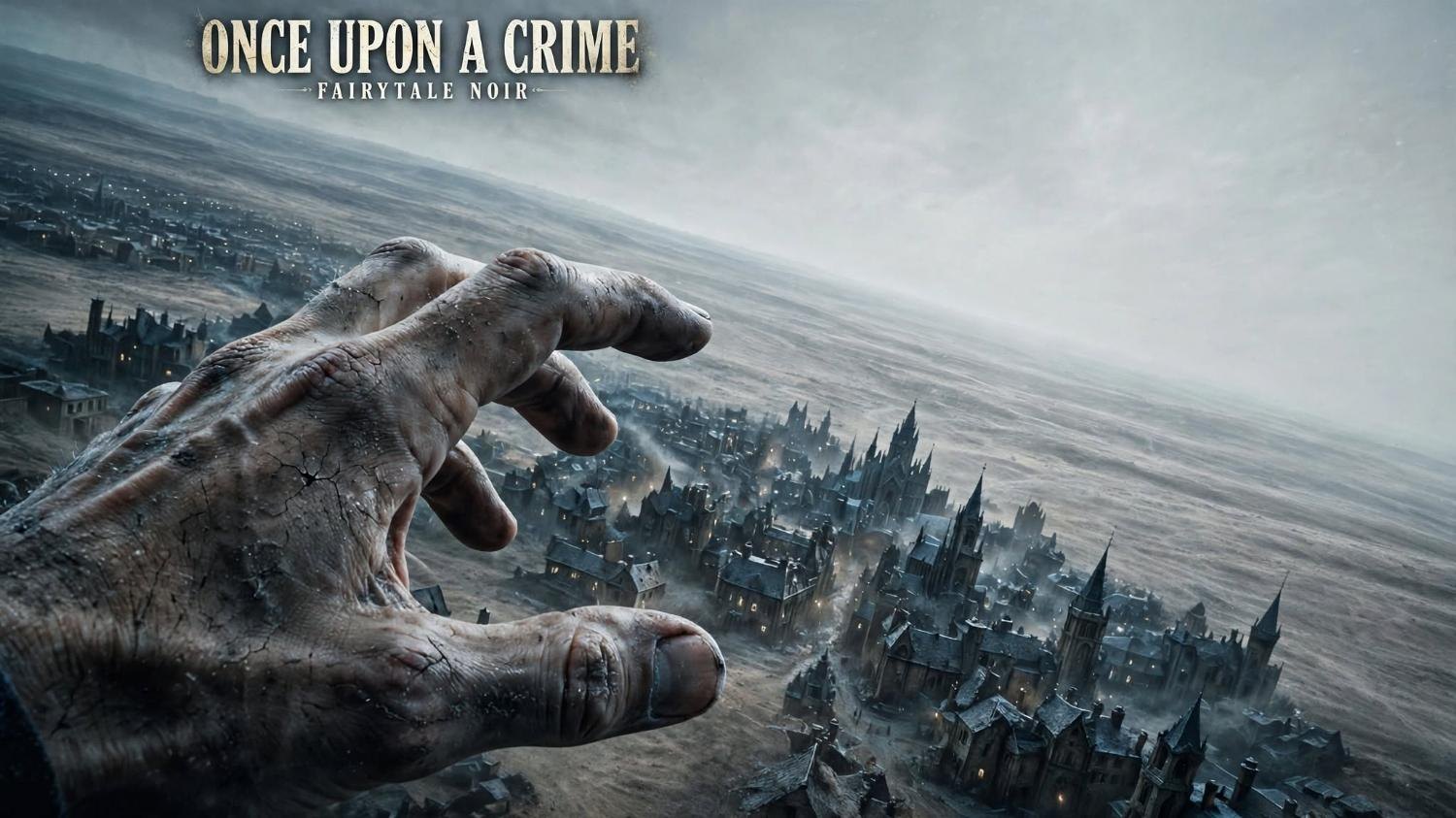
Beyond the glass, the horizon sits a few degrees off. Roofs lean that same few degrees, and once the lean is plain it does not ease. Chimneys agree with the roofs. A cracked hand, large enough to make a city look like a model, rests over the roofs without touching them. The cracks in the hand are dark and do not drip. The hand does not close. Rain strikes the roofs and does not strike the palm.
Three figures stand in a doorway at the side of the room, coats dark with rain. They look toward a village on the far side of the lean. The village is already still. Its lanes are empty. Its lights are out. A signboard creaks and does not swing enough to matter. Whatever the three came to see has already happened. Their coats drip on the threshold and not past it. One of them sets a palm on the doorpost and leaves it there. The wood darkens under the wet hand. None of them steps into the rain. The crossed-out title does not get a new word written under it. No pen is on the table. The book stays open at the refusal.
The cracked hand stays over the small city. It does not lower. The horizon keeps its wrong angle. A drop on the dirty glass finds a clean path and then loses it in the dirt again. Rain continues down the dirty glass, and the torn print dries on the table under the tag. The wolf, the basket, and the hooded shape remain a run of ink that has finished running. The three figures remain in the doorway. The village remains still. The title remains crossed out, and no one in the room writes a replacement above the hard line.
The palm on the doorpost does not slide. Coats drip and the drips slow. The large hand over the roofs keeps its cracks and its distance. Dirty glass keeps the rain. The print keeps its tag. The room stays behind the glass, and the village on the far side of the lean stays a village where the lights are already out.
No one turns the book to a later page. The hard line is the last mark the paper is going to get. Rain on the roofs does not straighten them. The three wet coats stay in the doorway. The village lanes stay empty. The cracked hand stays a hand's width above the model of a city, and the torn print under its tag finishes drying without growing a caption.