Hidden Geometry
Key art
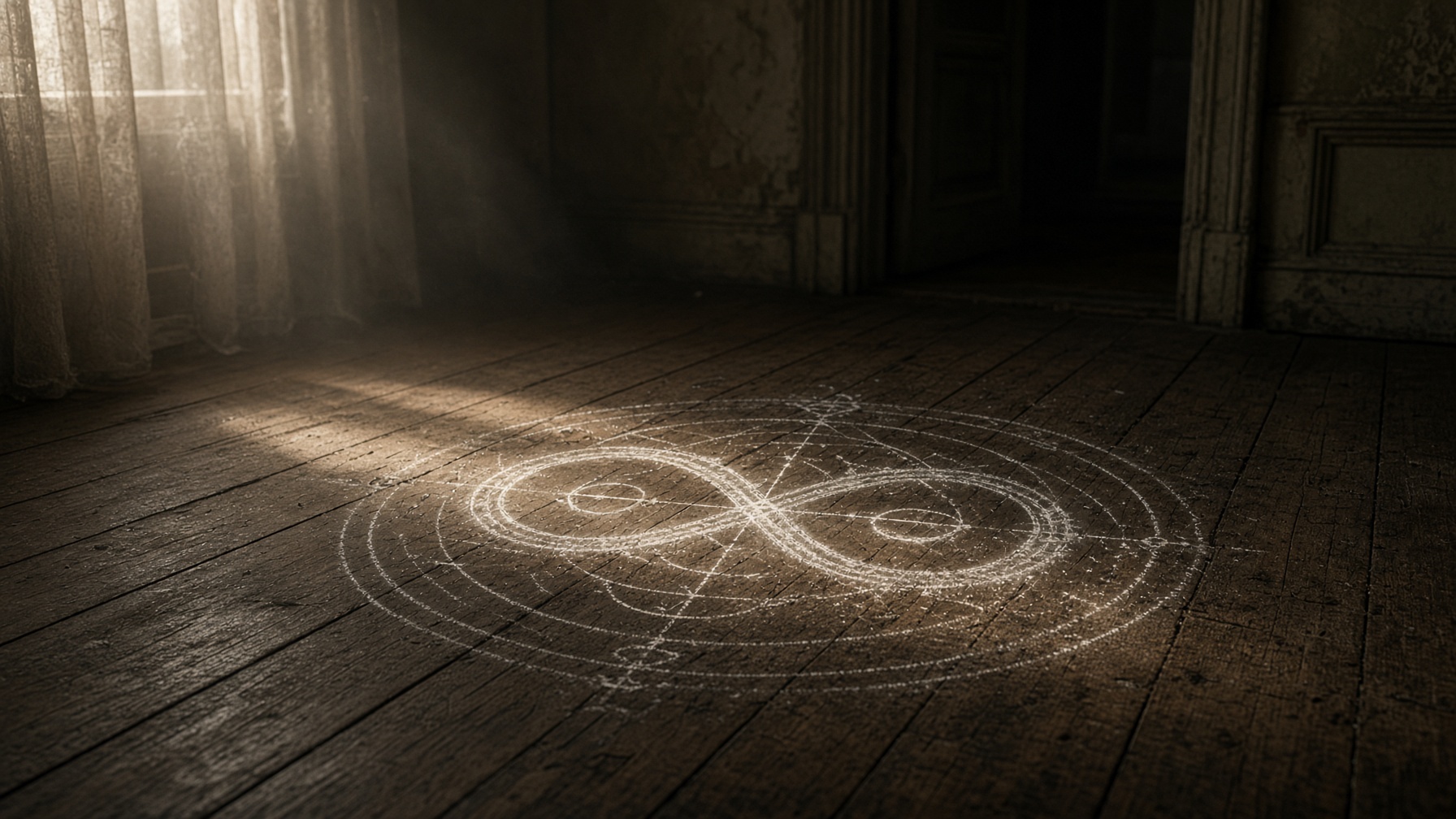
Filed beside the screening
The picture is Hidden Geometry.
Scenario
2:57 · 16:9
A woman arranging chairs for a meeting notices that the table, the window mullions, and the cracks in the plaster share an angle. She stands still long enough to be sure she is not inventing it. The same slant repeats in the worn path of the rug. She turns one chair to break the rhyme. The room's draft, which had been idle, slides along the new line and flutters the papers into the same angle again. The sheets travel, stop, and overlap so their corners agree. She stills the papers with her palm. They are warm from the slide. The pattern is not a picture she can finish. When she tries to sketch it on a scrap, the lines stop making sense the moment they leave the room and live on the paper. She turns the scrap. The nonsense does not become a room.
She moves three chairs until their backs, the door, and a worn path in the rug describe a triangle she could not see before she saw it. The chair legs complain and then sit. A cupboard door at the far end, shut all morning, eases open along that triangle's point. The hinge gives a small sound and no more. Nothing inside is unusual: cups, a stacked cloth. The cloth's folded edge lies on the same slant as the mullions. The opening itself is the event. She understands the geometry was not waiting as decoration. It answered. She does not take a cup. She does not shut the door.
She starts a chalk line on the floor to hold the shape, then stops halfway. The chalk dusts her fingers. The line already feels like a reduction. While she holds the chalk above the unfinished mark, the draft returns, follows the chalk as far as it goes, and dies in the gap she has not drawn. The cupboard door ticks, almost closing, and stays ajar when she does not complete the mark. A crack in the plaster lengthens a finger's width along the triangle and stops, pale and new. She sets the chalk down. It rolls to the edge of the line and stays. The chairs remain at the angle. She can no longer look at the room and see only furniture.
The unfinished chalk stops in the dust. One paper she stilled shifts back a fraction into the shared angle and does not travel farther. The cupboard stays a little open, cups unmoved, cloth still slanted. The triangle holds without being drawn to its last side, and her hand stays off the chalk while the long room keeps the shape it answered with.
She remains among the chairs and does not square them back to the table. The meeting they were set for does not begin. No other person comes through the door that makes one point of the triangle. The cups in the cupboard do not click together. The stacked cloth keeps the slant. Chalk dust on her fingers dulls and does not mark the floor again. The long room holds the unfinished line, the ajar door, and the angle the papers have agreed to, and she lets the draft die where she stopped drawing.