Fragment of a Larger Night
Key art
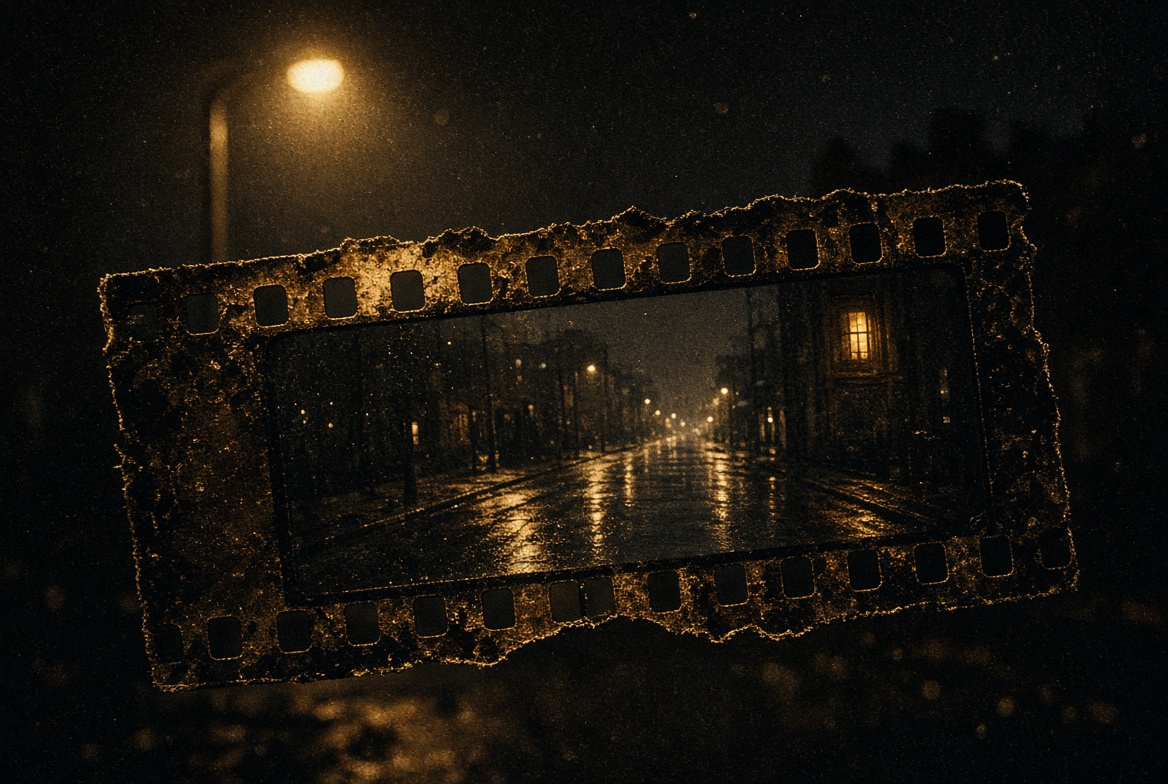
Filed beside the screening
The picture is Fragment of a Larger Night.
Scenario
2:57 · 16:9
Fen Arkwright keeps pieces of nights that were never stored as wholes. On the blotter lies one piece: a torn corner of a night log, a single hour, a streetlamp noted, a sleeve described and then the paper gone. The tear is rough. The ink stops mid-word at the rip. The rest of the night is implied by the tear and is not in the room. A tin beside his elbow is heavy enough to hold the missing pages. Dust sits on the lid in a dull skin. He does not open it and lay the night out. He rests a hand on the lid. The hand prints the dust and he does not blow the print away.
The fragment asks, by its broken sentence, for the verb that would finish the hour. Fen reads the line to its end, which is not an end. His mouth does not supply the missing verb. He lifts the tin lid a finger's width. Dark paper shows, the larger night waiting to be spread out and understood, edges packed tight. Supplying it would turn the piece into a trailer for a story he will not run. He shuts the lid. The click is small. Dark paper, in the last of the gap, slides lower inside the tin, a soft settling heard and not seen again.
The lamp shows the rough tear as a pale fur and does not show the pages inside the tin. Fen's fingers, ink-stained at one nail from other nights, stay off the fragment once the stamp is down. He does not fetch a second lamp to read what the tear ate. The streetlamp noted on the paper is only a word. No streetlamp exists in this room. The sleeve described there is only a few letters of cloth, color unfinished, owner unnamed. He lets those letters be enough. The tin's dust, printed by his hand, slowly loses the print as new dust does not fall and the old dust settles back into an even skin. He watches that healing of the lid and does not open it to stop the night from staying packed.
He squares the fragment on the blotter, weights it with a dry stamp, and leaves the tin closed. The stamp leaves no ink, only a pressure. Dust on the tin is not decoration. It is simply dust. The lamp shows the torn edge and stops. Time passes as the pressure dent in the fragment slowly eases and does not disappear. One letter at the tear pales, the ink giving up the last stroke of a word, and the word becomes even less of an ending. The fragment stays on the blotter. The tin that could have held the rest stays shut, the dry stamp weighting a corner that will not be completed tonight.
The dry stamp stays on the fragment and the tin stays shut.