Folder Without Owner
Key art
Filed beside the screening
The picture is Folder Without Owner.
Scenario
2:57 · 16:9
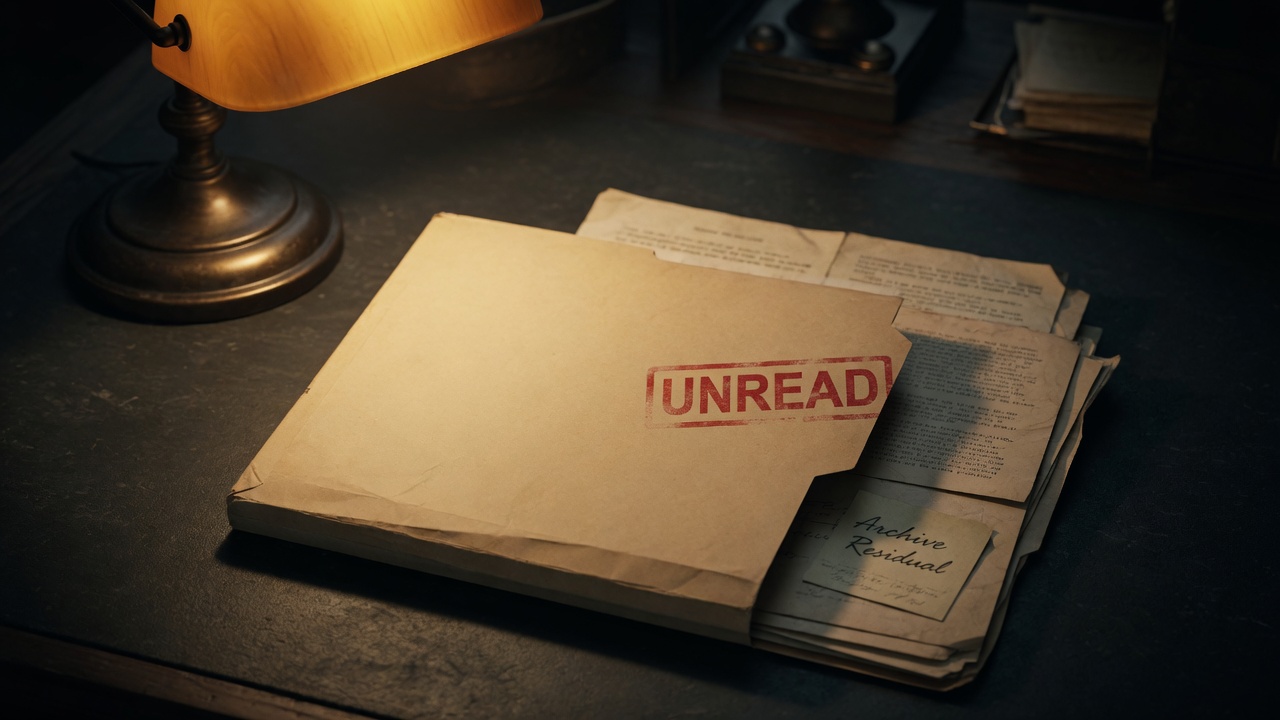
A table lamp burns over manila and a tray of blank cards. Stellan Pryce copies numbers. Names were someone else's field, and he does not borrow that field. The folder in front of him still wears its number, stamped clean, and the tab where a name belonged is bare. Oxide dust from an older sleeve dulls his cuff. He opens the folder. Inside, a blank card and a thin sheaf that never grew a biography. The pages are ruled and empty. A paperclip has left a rust ghost and no paper worth clipping.
He finds, caught in the crease, a scrap with half a sentence and no person attached. The half sentence ends where a name would start and does not start it. It would be easy to invent a life to fill the tab: a trade, a street, a reason the number exists. He sets the scrap back where it was, pressed into the crease, the words facing the binding. He dips a pen, writes the first stroke of a surname on the tab, and then stops. The stroke is a guess. He lifts it with a blade of eraser until the tab is bare again. Eraser crumbs gather in the lamp shadow. One crumb sits where the stroke was and is only a crumb.
Stellan squares the blank card inside the folder before he commits to the log. The card's corners are soft from other hands and still carry no writing. Oxide on his cuff does not transfer to the tab when he is careful, and he is careful. The lamp makes a small hot circle and leaves the rest of the file room in a workable dim. Other folders in the tray show names. This one will not join them. He reads the half sentence one last time without moving his lips and finds it still attached to no one: a verb, an object, and a gap. The gap is the whole point of stopping. He dips the pen again only to prove he can choose not to use it, and the point goes back to the rest without a second stroke.
The number remains. He enters that number in the log and leaves the name column empty. The empty column shows the pressure of a pen that did not write, a faint dent and no ink. He closes the folder and lays it in the tray with the decision already made: keep it, ownerless. Time passes as the crumbs, disturbed by the closing, scatter off the tab and leave it clean. The scrap in the crease works a millimeter out when the folder shuts, showing the start of the half sentence, and he presses it back in with a thumb until only manila shows. The folder shows its number. The name tab stays bare under the lamp, and the log's empty column keeps the dent of a surname he refused to finish.