Evidence Box 12
Key art
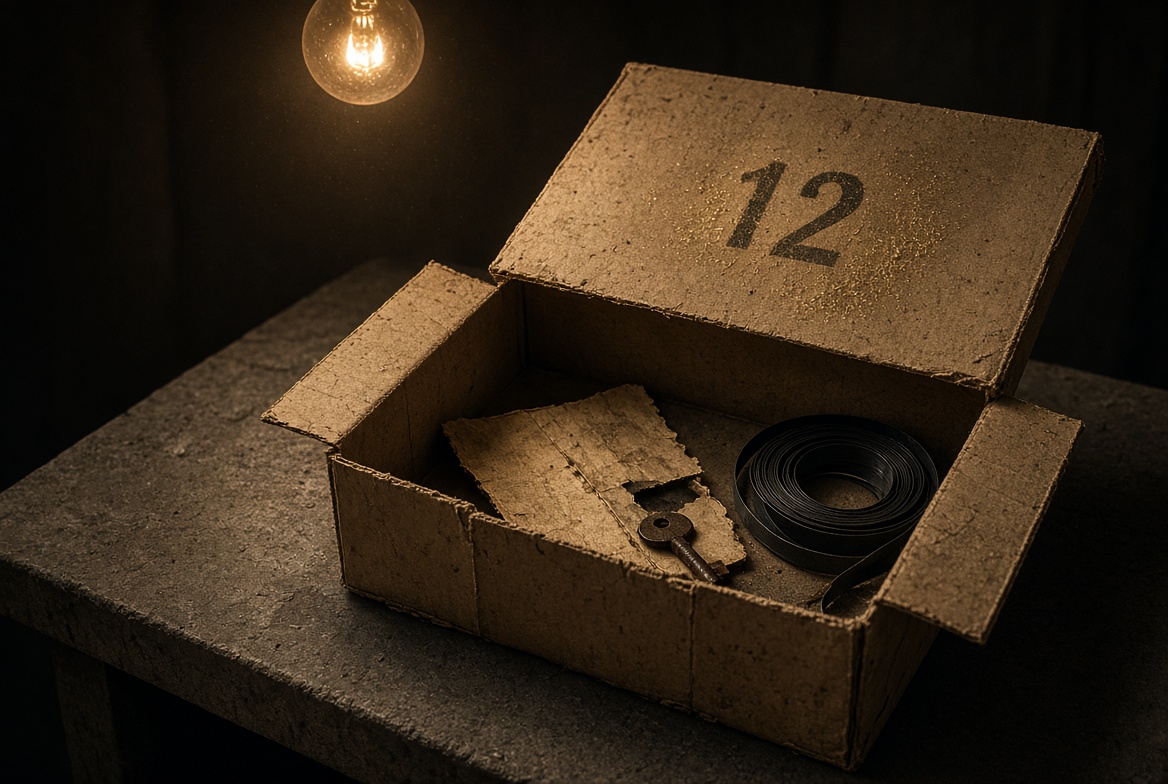
Filed beside the screening
The picture is Evidence Box 12.
Scenario
2:57 · 16:9
A table lamp and a stack of blank cards share a metal bench. The cards are clean, corners sharp, none of them written. Caspar Quinn sets down a cardboard box whose number is paint: a white twelve, brushed by hand, already dry. The brushstrokes show. He labelled it as if a case still existed. There is no trial in the room, no docket, no one waiting to be answered. Twelve is the paint. He treats the label as the thing that can be kept. He turns the box so the twelve faces the lamp and the paint looks a little warmer.
He lifts the lid. Inside, a manila folder holds a blank card and a coil of tired tape that sheds oxide on his glove. The oxide is brown and fine. No charge is named. No date of hearing. He almost writes a charge along the card to give the paint a job. His pen touches the card and leaves no word. The point rests, then lifts. Inventing a case would build a court this room does not have. He withdraws the pen. The card stays blank. The tape coil relaxes a fraction and sheds one more breath of oxide onto the folder.
The coil of tape, shut in the dark of the folder, gives a tiny tick as it settles, a sound like a small spring remembering it used to turn. Caspar hears it through the cardboard and does not open the lid again to stop it. The tick does not repeat. Blank cards on the bench reflect the lamp as a row of dull rectangles. He squares the stack and leaves it square. Unnumbered cartons on the shelf show crushed corners and no handwriting. The store has plenty of containers and only one number he is willing to claim, and that number is paint, not a charge. His pen stays capped on the bench, the point never having agreed to invent a court.
He closes the folder, fits the lid, and checks that the painted twelve is upright. The lamp stays on the box. He slides it onto a shelf between unnumbered cartons. The cartons do not gain numbers by being next to his. He does not add a story under the number. The bench keeps its blank cards. Time passes as the oxide on his glove dries to a dull smear he does not wipe onto the cards.
The smear, when his glove brushes the box in seating it, leaves a faint brown kiss on the edge of the white twelve. He sees it and does not repaint. The number is still twelve. Box twelve, painted and untried, sits under the lamp with its lid shut, a small stain on the paint, and the blank cards on the bench remain blank beside it.
The brown kiss stays on the white twelve and he does not paint over it.