Erasure Protocol
Key art
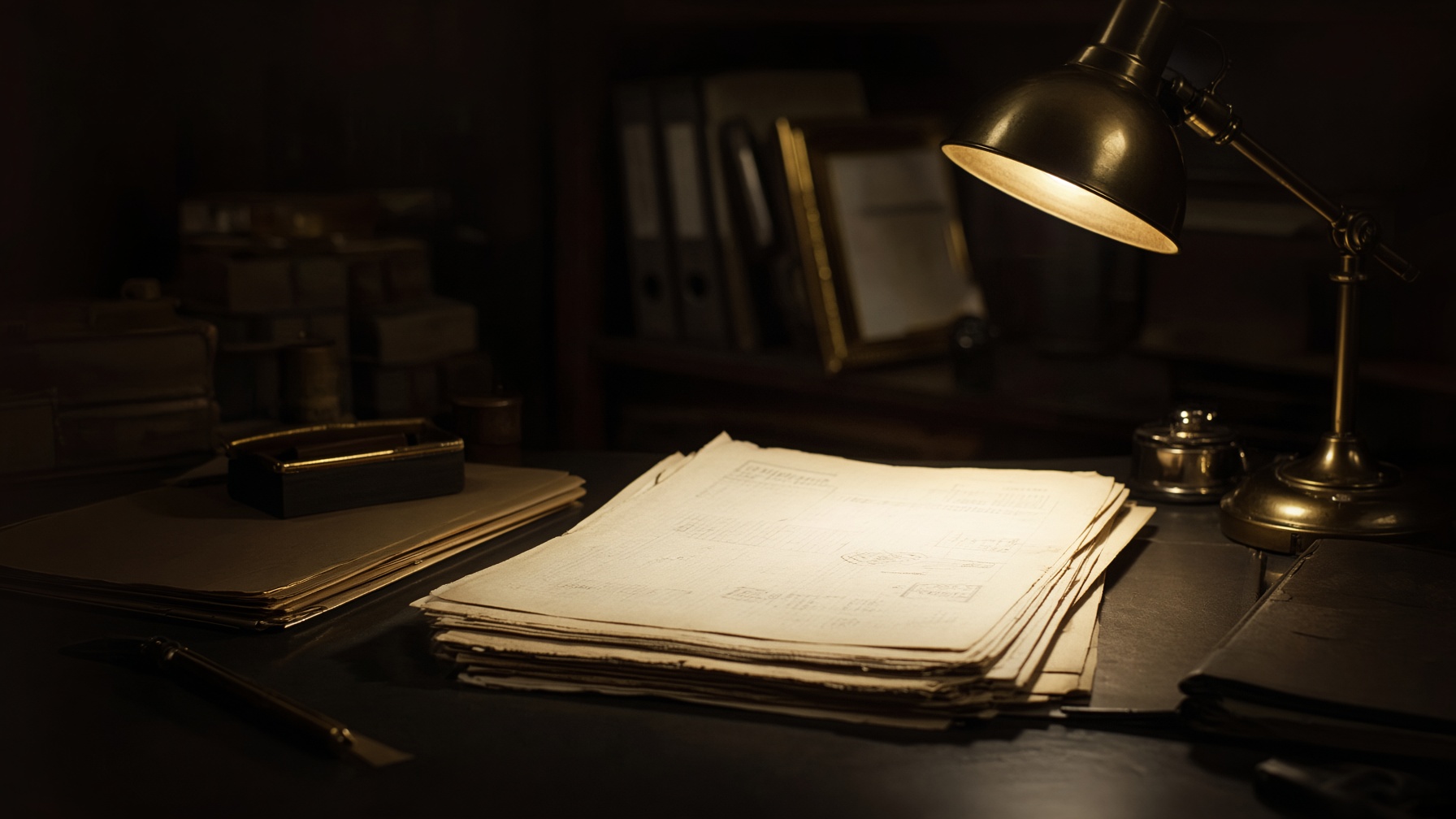
Filed beside the screening
The picture is Erasure Protocol.
Scenario
2:57 · 16:9
Vesper Lang works at a scarred desk with a lamp, a tray of forms, and a block of black ink. No screen shares the work. The scar in the wood is old and ink-stained at its edges. She takes a form that still has a stranger's name in a narrow box and lays the ink down in even strokes until every letter is covered. The strokes are patient. The boxes read complete. The protocol, on paper, is finished. She holds the form to the lamp and no letter shows through the black. She slides that form into a manila sleeve and sets the sleeve square to the desk.
She draws out a second sheet, the one that carries her own line. The ink there has already been lifted once. A pale trough remains where the pen pressed, an outline with no letters willing to stay filled. She can see it when the lamp rakes the paper and lose it when the lamp is flat. She wets a cloth and works the trough again. The paper roughens. Fibers lift. The outline does not leave. It sits in the fiber, empty to a glance and not empty to a finger. She runs a fingertip along it and feels the groove, letter-length, letter-gap, and still no letter she will say.
The lamp heat reaches the wet sheet and the damp gives up a faint smell of paper, nothing sweeter. Vesper turns the sheet a quarter turn and the trough catches the light along its whole length, a pale road with no name living in it. She turns it back. The stranger's sleeve, already dry, curls at one corner as the room's air finds it, and she presses the corner flat with a clean finger. The black inside does not crack. No letter climbs out of that black to replace the one she covered. The corridor beyond the bell stays empty of anyone bringing a fresh form.
A clerk's bell rings somewhere down the corridor and fades. Vesper does not call a name back into the trough to soften it. She does not invent a fresh line to stand where the old one lived. She blots the damp, sets the sheet under the lamp, and waits while the water leaves. The waiting is the rest of the work. The completed stranger's form is a flat black quiet in its sleeve. Her own sheet looks blank until the lamp rakes it. Then the outline returns, paler than the paper around it and darker than a true blank.
Time passes as the water retreats from the edges of the sheet toward the trough and disappears there. A single fiber along the trough lifts and lies back down in a curve that is almost a letter and is not one, and the curve stays. The outline of her name dries in the fiber. Her cloth stays folded beside it, damp at one corner, and the black sleeve of the stranger's form does not open again.