Dust Settlement
Key art
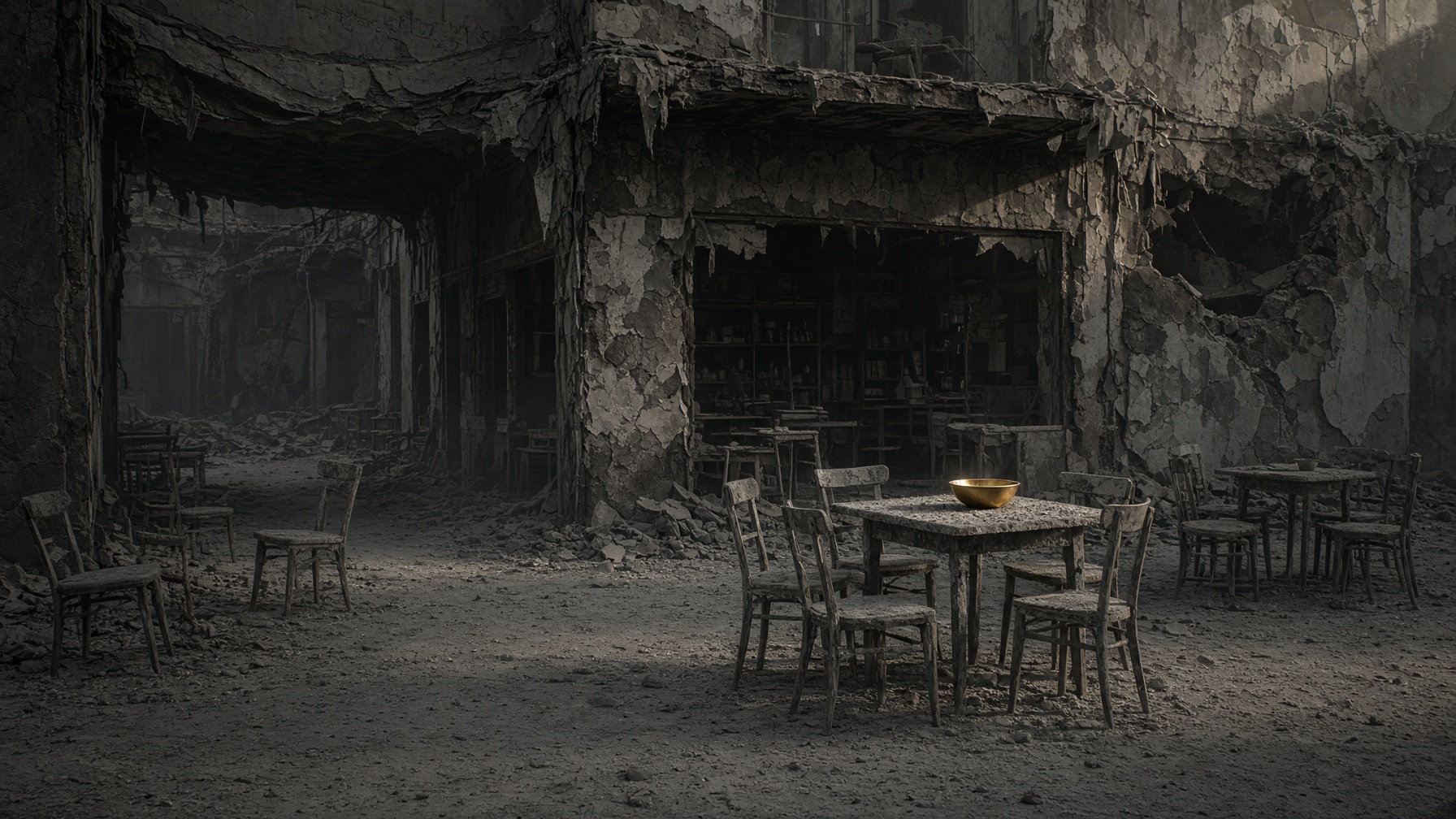
Filed beside the screening
The picture is Dust Settlement.
Scenario
2:57 · 16:9
The air has finished falling. Grey lies on the table, on the chairs, along the window rail, in a layer that no longer drifts. The light through the glass is flat and shows every surface as the same decision. Eamon Drift stops inside the door with a folded cloth in his hand, because cleaning other people's rooms was his living, and this grey is not his to lift. He stands long enough for his own shoes to print the grey by the threshold and does not scuff the prints away. The room accepts the prints and does not otherwise acknowledge him.
He opens the cloth over his palm. He knows the motion: one pass, then another, until wood shows. He does not make it. Moving the dust would pretend the day can start again, and the day has already chosen its surfaces. He folds the cloth smaller, corner to corner, and sets it on the seat of a chair, beside the grey, not on top of it. The cloth's clean square stops at the dust's edge. A boundary no one asked for holds.
He walks once around the table. The near edge is thicker than the far, as if the particles had preferred that board. His fingers hover over the thick edge and do not test it. A broom leans in the corner where a former tenant left it, bristles grey at the tips, handle still the color of wood. He does not take it. Stillness is the only inventory that does not lie. He counts surfaces instead of clearing them: table, two chairs, sill, the top of a cold lamp. Each one wears the same uninterrupted coat. The lamp's switch is under the grey and he does not seek it.
Eamon's walk around the table ends where it began, at the door prints, which have not filled themselves in. He looks at the broom and leaves it leaning. The cold lamp stays cold. Grey on the sill is deeper in the corner than in the middle, a preference he records only by seeing it. He does not open the window. He does not shake the cloth out. The room's quiet is not a pause before work. It is the work's refusal, and he stands inside that refusal without performing a rescue of the wood.
The cloth stays folded. The grey stays where it settled. Nothing in the room restarts. Time passes as one last mote, late to the settlement, lands on the thicker edge and becomes indistinguishable from it. A single grain leaves the air and settles on the folded cloth, the first mark on the clean square, and he does not brush it off. The broom's bristles shed a dry thread onto the floor grey. The thread lies still. Grey lies unbroken on the wood, and the cloth remains where he set it down, one grain darker than his intention and no less folded.