Day the City Forgot
Key art
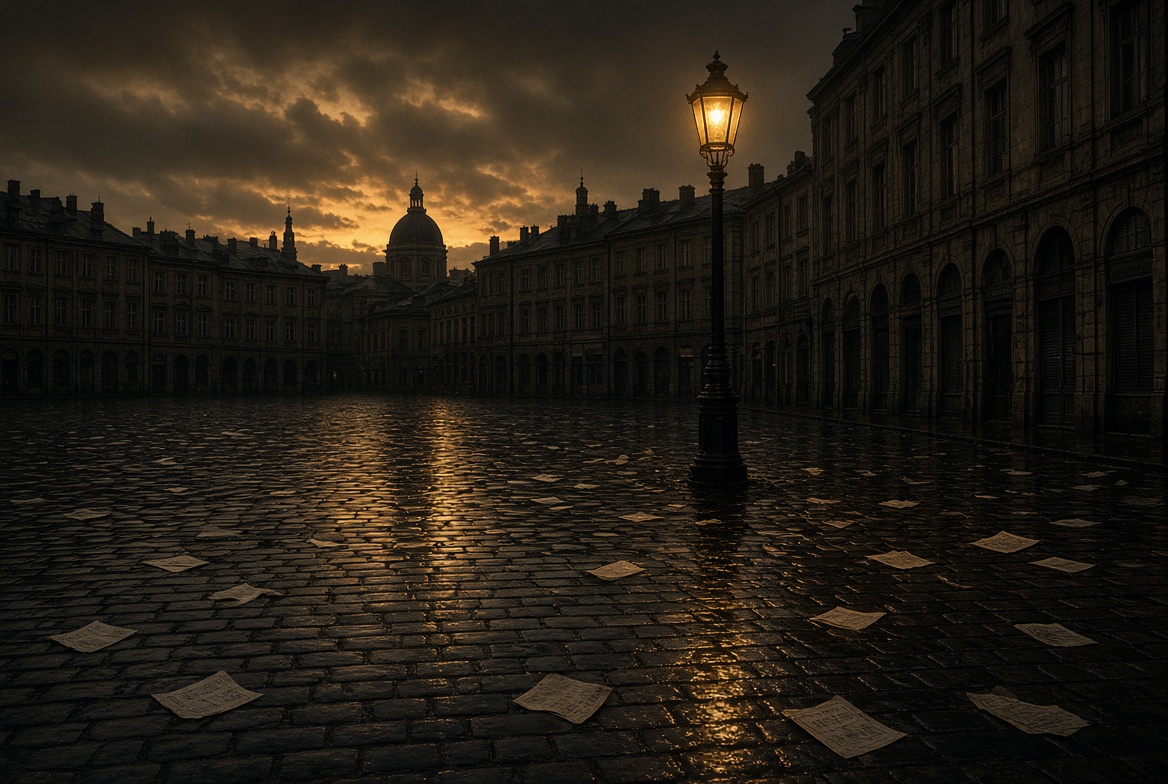
Filed beside the screening
The picture is Day the City Forgot.
Scenario
2:57 · 16:9
Della Frost keeps civic dates. The logbook is open to a month of squares, most of them filled in a small even hand: collections, closures, a bridge inspection, a market that did not require drama. The ink of those entries is dry and alike. A stamp sits in its tray, ink still damp from the square she finished a minute ago. The damp square shows a clean impression, edges sharp, the city's ordinary business acknowledged. Quiet hours go in because they passed. The book is still the work. No one stands at her shoulder. The office around the desk is a row of empty chairs and a window with the blind half drawn on a street that continues without asking the book for permission.
She reaches the square the city left for itself, the civic date in the middle of the week. The square is larger than the others by a rule of the ruling, and it is blank. Her pen starts the first stroke of the numeral and stops. The stroke is a hook with no number yet. The blank is not an accident she is about to repair. She lifts the stamp, holds it over that square until the shadow of it is a date-shaped threat, and then moves her wrist to the margin. The stamp comes down beside the square, marking that the hour was considered, not that the date was kept. The impression in the margin is as clean as the one she made a minute ago, and it means the opposite.
The office clock, if there is one, does not hurry her. She listens and hears only the blind cord tapping the window once when a draft finds it. The tap is not an entry. She lets the cord go still. The filled squares above the civic blank remain filled, their small even hand unchanged by the refusal under them. The damp stamp she used a minute ago is already losing its wet edge, becoming the same dry black as the older marks, while the civic square accepts none of that black.
She fills the next square, an ordinary delivery, the words small, the time noted, and leaves the civic one empty on purpose. No one leans over her to call it a mistake. The hook of the unfinished numeral dries into the paper and stays a hook. She blots the margin. The stamp's extra ink thins. She caps the pen. The cap clicks. She lets the blank remain the entry.
Time passes as the damp ink in the tray skins over, a dull film on a shine. The shadow of the stamp, which had threatened the civic square, does not return, and the blank inside that square looks cleaner than the squares around it, as if refusal had wiped a place the pen never filled. The civic square stays empty. The stamp rests in its tray, ink already dry, and the hooked stroke beside the blank dries into a mark no one will finish into a date.