Colony Lights
Key art
Filed beside the screening
The picture is Colony Lights.
Scenario
2:57 · 16:9
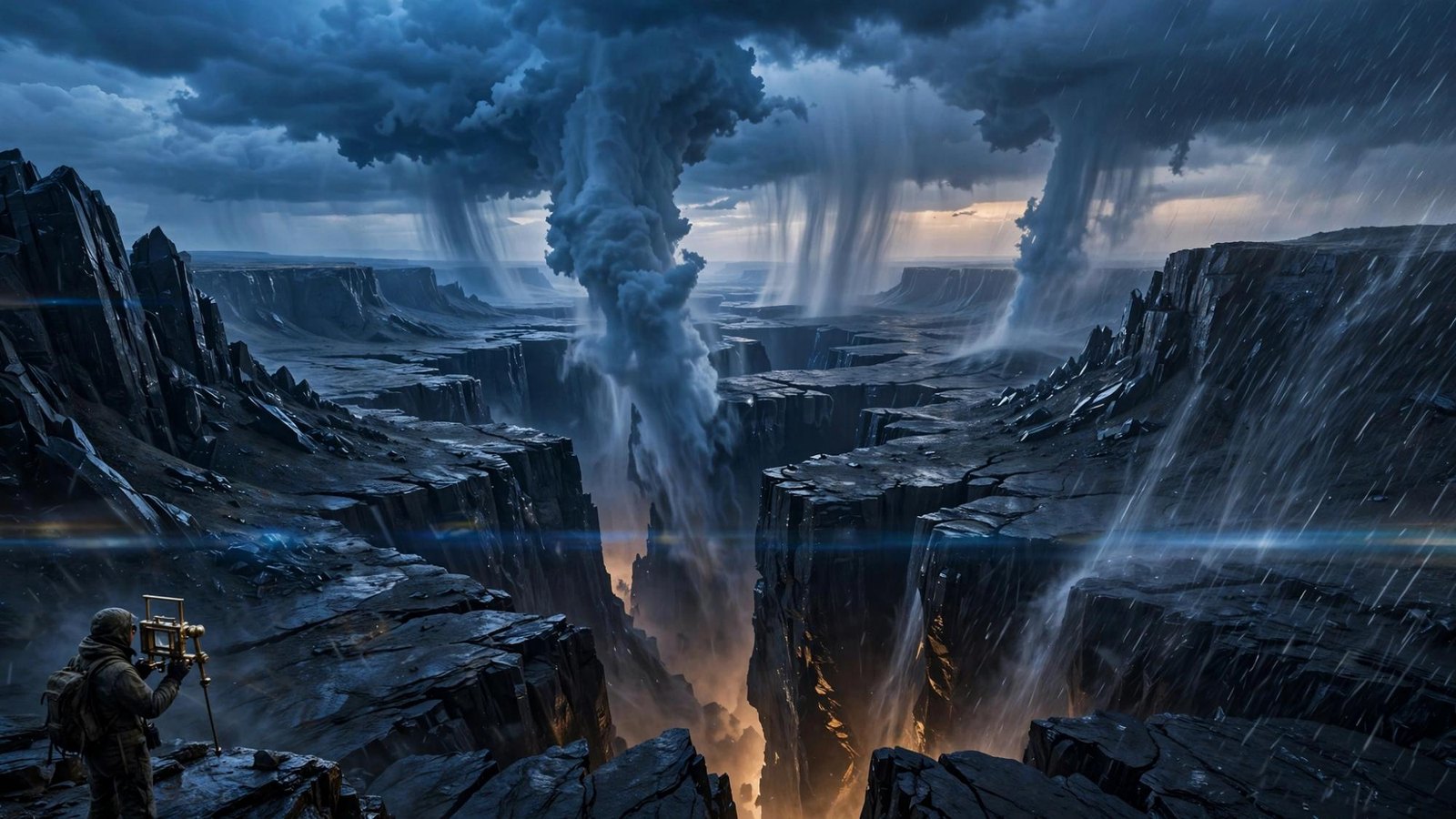
A figure stands alone on a basalt ridge. The canyon is open under the storm. There is no street in it. Wind pulls at the coat and at a strap on an instrument fixed to a tripod. The figure keeps a hand near the instrument and does not count out loud. Needles, if the instrument has them, are not read aloud. The canyon does not resolve into anything with a door. Cloud moves low and does not break into a shape a person could enter. Rain has not arrived. The air only tastes of it.
Lights kindle on the canyon floor, row after row, the pattern of a colony switching on. They come in order, near ridge first, then farther, a grid of small warm points where stone was. The figure does not count them. The points hold. In the cabin behind the ridge, a map lies under a lamp. The window of the cabin is the canyon, not a grid. While the figure watches the lights, the map draws streets by itself, fine and sure, matching the rows. Ink appears as a hairline, then a crossing, then a name-less block. The lamp does not flicker to explain it. The figure does not go to the table yet. The tripod creaks once in the wind and holds.
The canyon lights go out. They go in the order they came, far rows first, then the near, until the floor is stone again. The storm remains. The streets on the map do not go out. The figure comes to the table, looks from the new lines to the window, and stays at the edge of the table. A hand hovers over the freshest street and does not touch the wet ink. Outside, the tripod stands empty. The coat's absence is a smaller dark on the ridge. The canyon is only stone and weather.
He does not count the dried streets either. The tripod outside ticks when the wind changes and then stands mute. A drop hits the cabin roof, one, and does not become rain on the map. The figure's coat hem drips once onto the boards by the table and the drop stays round, separate from the ink.
Time passes as the lamp hums and the ink dries from the center of each new line toward its end. The newest street on the map continues a short distance after the last canyon light has died, a line drawing itself into blank paper, and then it stops mid-stroke, unfinished, with a small bulb of ink at the tip. The figure does not blot it. The map keeps its streets under the lamp. The window keeps the empty canyon. No light returns to the floor of it, and the drawn city stays on the paper alone, the unfinished stroke drying where the rows ran out.