Audience of One
Key art
Filed beside the screening
The picture is Audience of One.
Scenario
2:57 · 16:9
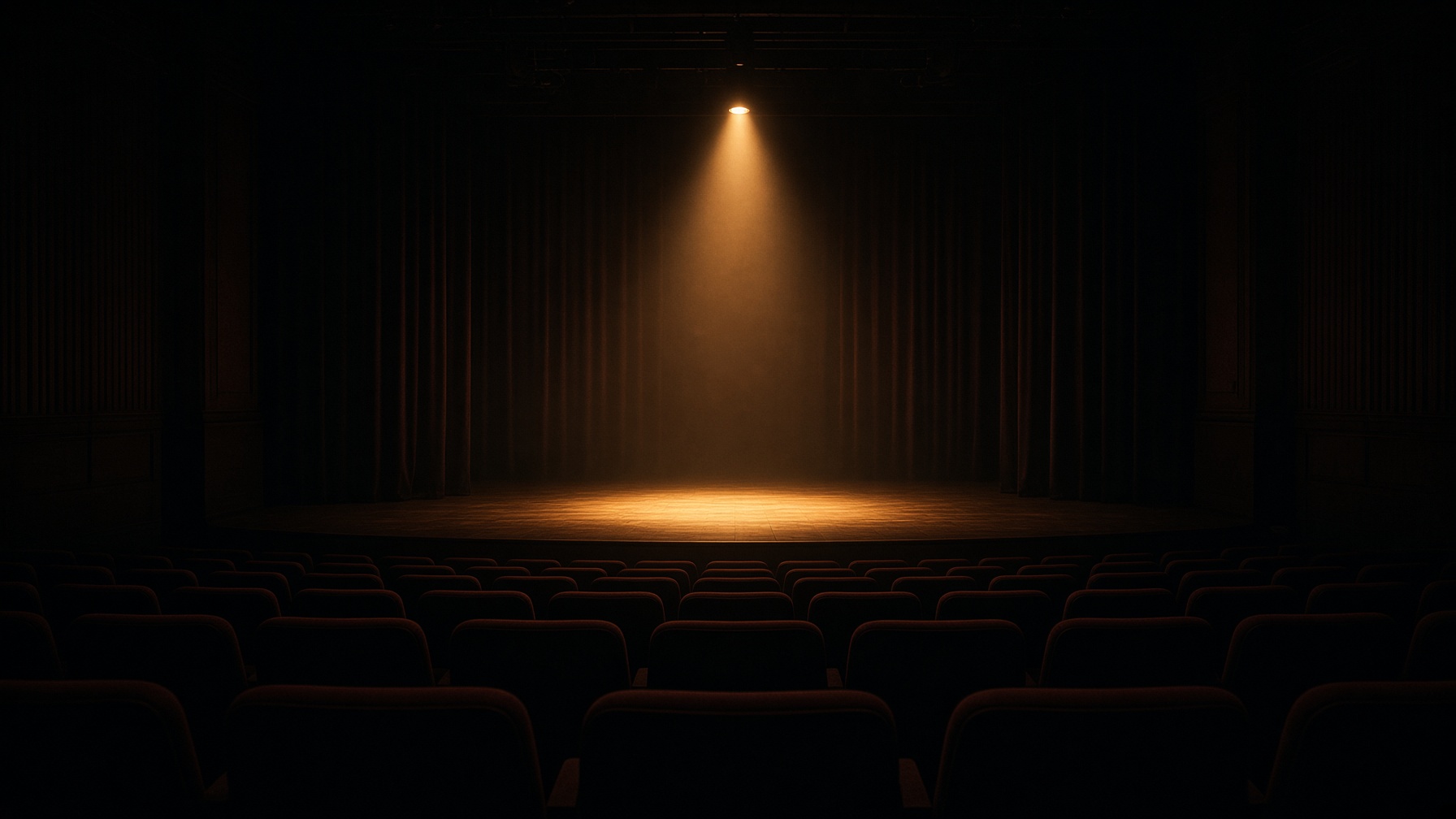
A stage is lit for a reading. One pool of light, a chair, a stand, and the rest of the boards in dusk. Rows of seats run back into the dark, all of them empty except one, off to the side, where a woman sits with a program folded square on her knee. She is not in the place a guest of honor would choose. The seat beside her is empty. Dust on its cushion has not been disturbed. Onstage, a man in a dark suit reaches the end of a passage and pauses where applause belongs. His hands hover, open, at the height of a thanks. The pause lasts the exact length of a bow. No hands answer from the dark. A seat spring somewhere in the center does not even tick. He holds the pause one breath past its courtesy and lets it go.
He continues, because the next cue is his. His voice finds the boards and stops there. The woman in the side seat moves her mouth with him for three words, a fraction early, as if she still knows the order and cannot stop keeping it. The whisper is barely a whisper. He hears it and loses a line. The lost line hangs between them. He finds it again by watching the floor, not the seats, and goes on with his eyes down. At the next appointed pause he bows to the empty center. The bow is exact, aimed at the aisle no one occupies. The seats hold still. She does not clap. She sets the program on the neighboring cushion, aligning it with the arm, the way an usher would, square to the wood, and takes her hands back to her lap.
He speaks the final sentence. The work lights do not rise. The pool stays the pool. He stays in it through the silence that should have been covered by noise. His hands lower to his sides. She remains seated, hands folded, no longer mouthing the words. The program on the next cushion keeps the alignment she gave it. Minutes pass as neither of them fills the dark. A rope somewhere above the pool creaks once in the heat and goes quiet. His stance does not break. Her folded hands do not separate. The stand in front of him holds no page that turns.
The program, so carefully set, slips a quarter inch when the cushion exhales, and she does not put it back. The slip leaves a thin line of dust along one edge, the only new mark in the house. He does not bow again. She does not cover the silence with her palms. The lit stage holds him through the long quiet, and the empty rows keep the shape of a habit that has outlasted its public, the slipped program marking the only seat that was almost used.